

The Power of Local Leadership
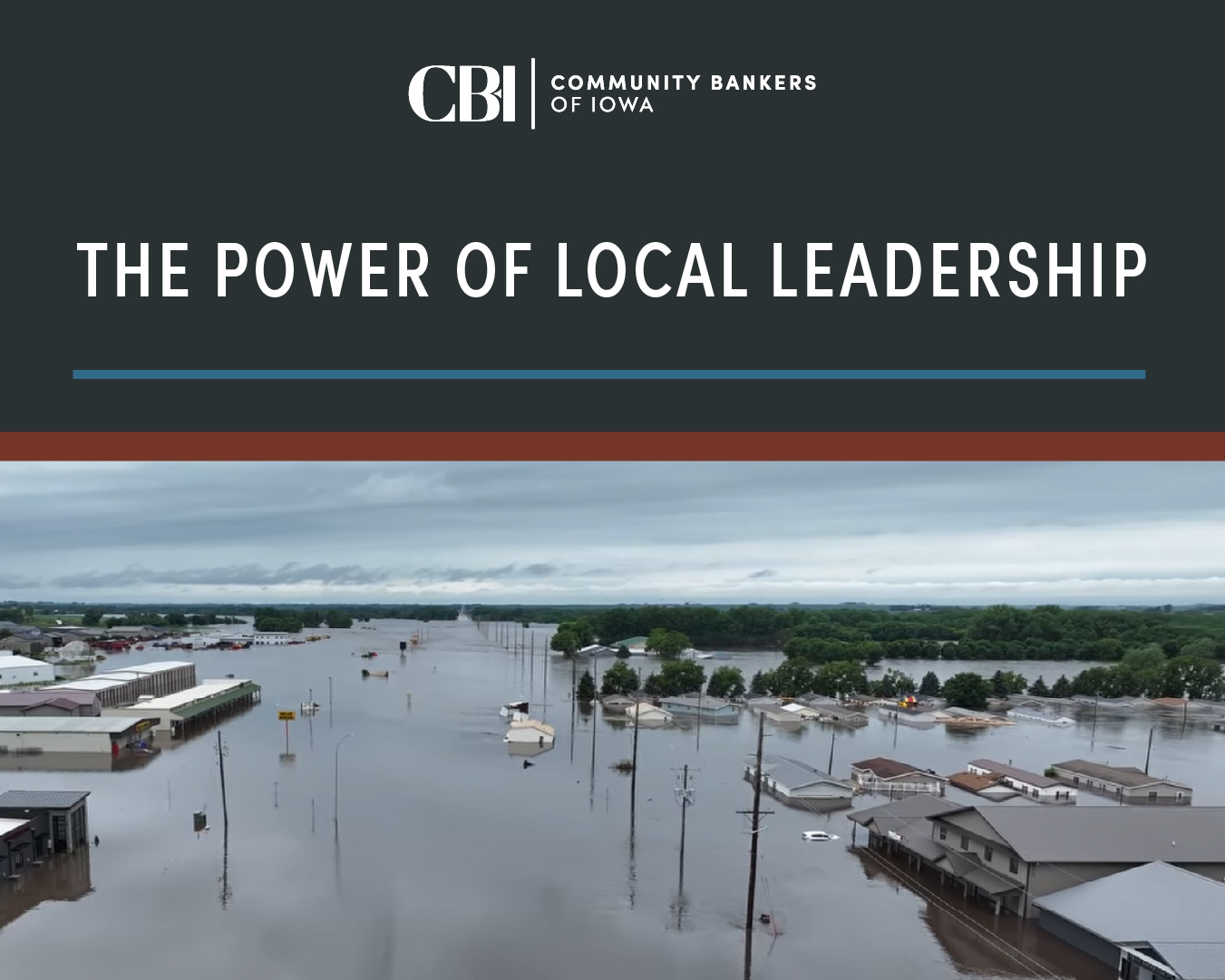
Most people remember where they were when the floodwaters rose in Northwest Iowa in the summer of 2024. They remember the streets under water, the sandbags lining neighborhoods, and the long days that followed.
What many may not have fully seen is what happened next.
In moments like these, leadership does not wait for permission. It begins at the local level. As families and businesses began navigating insurance claims and federal assistance, the recovery process officially moved forward. FEMA’s process is thorough and structured for large-scale disasters, but it takes time. And in the middle of uncertainty, waiting can feel long.
Communities needed momentum before federal dollars could move. Across Spencer and Rock Valley, independent community banks stepped forward as they always have, not with fanfare, but with focus. While larger systems worked through required steps, local community bankers relied on something they already had: trusted relationships and a deep understanding of their communities.
When It Became Real
For many bankers, the reality of the flood hit suddenly.
Mike Bryan of Farmers Trust and Savings Bank remembers walking along the river that Saturday morning and seeing the water rise. Hours later, he returned to the bank.
“I was sitting in my office, and saw the water was two feet deep on my outside wall and flowing into the lobby,” Bryan said. “Looking out the window, there was water everywhere. That’s when it became real to me.”
Ryan Johnson of State Bank had a similar moment. “When I saw water in the streets on the west side of town, we knew this was going to be bad,” he said. “The bank got completely surrounded, and it didn’t take very long.”
Jason Warren of Northwest Bank noticed something wasn’t right even before he reached his office. “There was water in streets that I’d never seen water in before,” Warren said. “That was my first red flag.”
In Rock Valley, the flood surpassed even historic expectations. Wade Gort of Premier Bank described the scale:
“This one turned out to be another five feet higher than the 2014 flood,” Gort said. “Nobody thought that was possible.”
Within hours, evacuations began. Homes filled. Families were displaced.
Like their customers, these bankers were managing personal loss even as they prepared to serve their communities.
Relationships Already in Place
In Spencer, three CBI member banks—State Bank, Farmers Trust and Savings Bank, and Northwest Bank—were serving customers facing enormous uncertainty. Leaders including Ryan Johnson of State Bank, Mike Bryan of Farmers Trust and Savings Bank, and Jason Warren of Northwest Bank were in constant communication. From the outside, banks may appear competitive. Inside their communities, collaboration is the norm.
“We’re all collaborators,” Johnson said. “We care about each other, and we’ve always worked together on things like this. We will always work together to make Spencer a better place.”
In the days following the flood, the banks shared information and monitored for fraud risks.
“Anytime there’s a disaster like this, you’ve got to watch for fraud,” Bryan explained. “We wanted to make sure we were all working together, trying to protect the community.”
The community banks also compared approaches to loan extensions, and walked alongside families navigating insurance claims and federal assistance.
“I think we were all kind of in community mode,” Warren said. “Nothing was ever really said that this is what we need to do. It was just: what customers need help? What do we need to do?”
When leadership is local, collaboration is not a strategy. It is a given.
Investing in What Matters Most
One of the clearest examples of collective leadership in Spencer came when flood damage severely impacted Spencer’s schools. Delays were not an option. Students needed classrooms, families needed stability, and the community needed a clear signal that progress was possible.
Together, Spencer’s community banks stepped forward to jointly purchase the $5 million bond issue needed to fund school repairs, ensuring work could begin without delay.
“There was no hesitation,” said Johnson.
Warren added, “We all talked within the first day and said, let’s do this.”
“A solution was needed while the community waited for FEMA,” Bryan said. “And this was it.”
Students returned to classrooms, teachers resumed familiar routines, and lights came back on in hallways that only weeks before had been filled with water.
That is what local investment looks like.
Leadership in Rock Valley
The same pattern unfolded in Rock Valley, where the flooding was even more severe on a per capita basis. More than 500 homes were affected. Recovery required more than cleanup. It required coordination, financial guidance, and long-term commitment.
Wade Gort and Greg Westra of Premier Bank worked alongside city leaders and organizations such as Friends of Rock Valley to help raise and distribute millions of dollars in relief funds. Decisions about how those funds were allocated were made locally, by people who understood the needs behind each application and the families behind each form.
“You don’t have time to wait for somebody that’s not in your hometown to make decisions,” Gort said. “We can make a decision, and we’re going to do it.”
Bank employees stepped in as neighbors first helping with cleanup, volunteering their time, and supporting relief efforts while continuing to serve customers with smaller operational teams.
“We told employees, if you’re not affected, go help somebody else,” Westra said. “Help your neighbor. Help your co-worker. Help the church. Whatever needs to be done, go do it.”
Premier Bank also offered flexible lending solutions to support rebuilding, helping families navigate temporary housing, existing mortgages, and uncertain timelines.
Recovery in Rock Valley has not simply been about replacing what was lost. New homes are being built on higher ground. Facilities are being improved. The community is rebuilding with resilience.
A Reflection of the Community
What stands out most is not only what community banks did, but how communities responded.
High school students showed up to clean buildings. Neighbors asked strangers, “What do you need?” Families made the choice to rebuild rather than relocate.
In Spencer, community banks feared an overwhelming wave of foreclosures.
“We were nervous about that,” Johnson said. “You were hearing rumors that keys were being dropped off everywhere.”
But that never happened.
“We did not get a single house back,” Warren said. “That’s a testament to the people here.”
In Rock Valley, Gort reflected on how the community responded to unprecedented loss.
“We said early on the flood wouldn’t define us, it would refine us,”
he said.
New homes are now being built on higher ground. Businesses have upgraded and expanded. Communities are rebuilding with resilience.
Independent community banks did not create that spirit. They reflected it, and reinforced it.
As Johnson put it, “The reason these banks are successful is because of the community. They’ve made us successful too. So it’s our duty to help out and provide what the community needs.”
Strong communities and strong community banks depend on one another. One does not thrive without the other.
In Northwest Iowa, that partnership was not theoretical. It was visible in every sandbag placed, every phone call made, every loan extended, and every classroom light turned back on.
And it is a reminder of what local leadership truly means.