

Fraud & Security Panel Preview: Energize Your Security Plan
Faster payments, digital transactions, and evolving customer expectations are reshaping how banks approach fraud prevention and security. As payment options expand, so do the risks tied
to ACH, card payments, instant payments, and e-commerce activity.
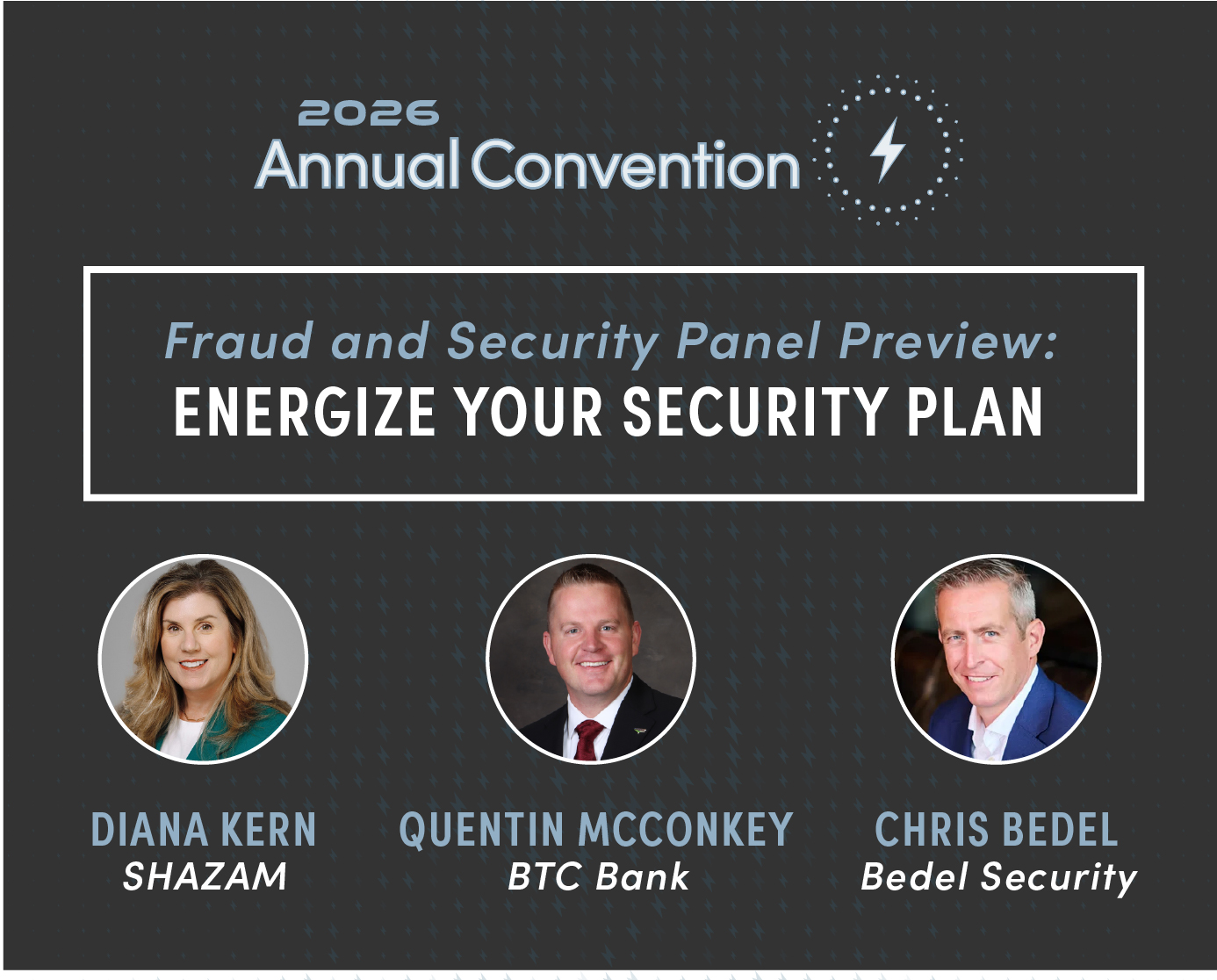
That will be the focus of this year’s Fraud and Security panel discussion at the 55th Annual Convention, featuring Diana Kern, Sr. Financial Solutions Consultant at SHAZAM, Quentin McConkey, Fraud & Security Officer at BTC Bank, and Chris Bedel, Owner of Bedel Security.
According to Diana Kern, one of the biggest realities banks are facing is that fraudsters evolve alongside payment innovation.
“Every payment innovation pushes criminals to evolve their methods,” Kern said. “It takes conscious effort to identify and understand the vulnerability of anything new before you deploy it.”
Kern, who works extensively with financial institutions on payments strategy, fraud mitigation, and EFT compliance, noted that social engineering continues to be a common thread across nearly every payment channel.
“Manipulation of humans, the weakest link in the chain, is the common thread running through all payment channels,” she said.
Quentin McConkey is seeing those tactics play out in increasingly aggressive ways. Fraudsters are using text messages tied to unpaid tolls, fake online purchases, and other urgent requests to pressure customers into responding before they stop to think.
“AI tools allow fraudsters to send significantly more messages with little effort, so customers are being bombarded with more attempts than ever,” McConkey said.
He also pointed to a rise in romance scams originating on social media that later evolved into money mule schemes.
“We consistently remind customers: if you weren’t expecting a message, be skeptical and don’t engage,” he said.
The panel discussion will also explore how banks are balancing customer convenience with stronger fraud controls behind the scenes. That includes everything from authentication measures to analytics-driven monitoring tools designed to identify suspicious activity before losses occur.
“At SHAZAM, we’re helping clients understand where more friction, like a one-time passcode, is warranted for e-commerce purchases,” Kern said. “And we rely heavily on data analytics to test and implement global and custom neural network rules.”
While payment fraud continues to evolve, Chris Bedel believes many banks are still struggling to define what strong information security actually looks like in practice.
“They're getting pulled in multiple directions by vendors, regulators, and examiners, often with conflicting guidance,” Bedel said. “What we try to build with our clients is a foundation of good practices, good processes, and good policies.”
Bedel, a former community bank Information Security Officer and now a consultant focused on strategic information security, emphasized that there is no “silver bullet” when it comes to cybersecurity preparedness.
“The things that move the needle most are the basic things done consistently and well,” he said.
That includes comprehensive risk assessments, regular governance meetings, meaningful metrics, and ongoing conversations around risk management. Bedel also noted that many banks overlook critical vulnerabilities tied to authentication controls around email, which continues to be a common source of breaches.
Beyond technology, all three panelists emphasized that fraud mitigation and security awareness cannot sit solely within operations, compliance, or IT departments.
“Everyone in the bank who has contact with customers needs to be aware of your standard messaging and know how to respond,” Kern said. “Help your accountholders be part of the solution.”
McConkey believes front-line training remains one of the most important and most overlooked areas of fraud prevention.
“They are often the first contact for a customer experiencing fraud,” he said. “The better equipped they are to identify it and guide the customer, the greater the chance of preventing a loss.”
Bedel added that employee awareness will only become more important as AI-driven attacks become more sophisticated and personalized.
“If I'm a sophisticated attacker and the technical entry points are locked down, the only way in is through your people,” Bedel said.
The panel discussion will focus on practical strategies banks can implement today while also addressing broader shifts happening across payments, fraud prevention, cybersecurity, and AI.
For McConkey, the conversation ultimately comes back to the customer experience and how banks respond when fraud occurs.
“As bankers, do we bring the right mindset to fraud cases?” he said. “Regardless of the dollar amount, for that customer, this may be the most significant thing happening in their life right now.”
Bedel hopes attendees also leave thinking seriously about AI and how quickly it is changing the industry.
“Any bank that isn't actively talking about it, thinking about it, and putting together even small test groups to start working with it is missing a window that is closing faster than most people realize,” he said.
Kern hopes attendees walk away thinking differently about payments strategy and risk management.
“Think of your payment options as products,” she said. “Understand the pros and cons of each and regularly evaluate the ROI for each. Efficiencies and shortcuts aren’t synonymous.”