

Reflections from the Federal Reserve’s Inaugural Community Bank Conference
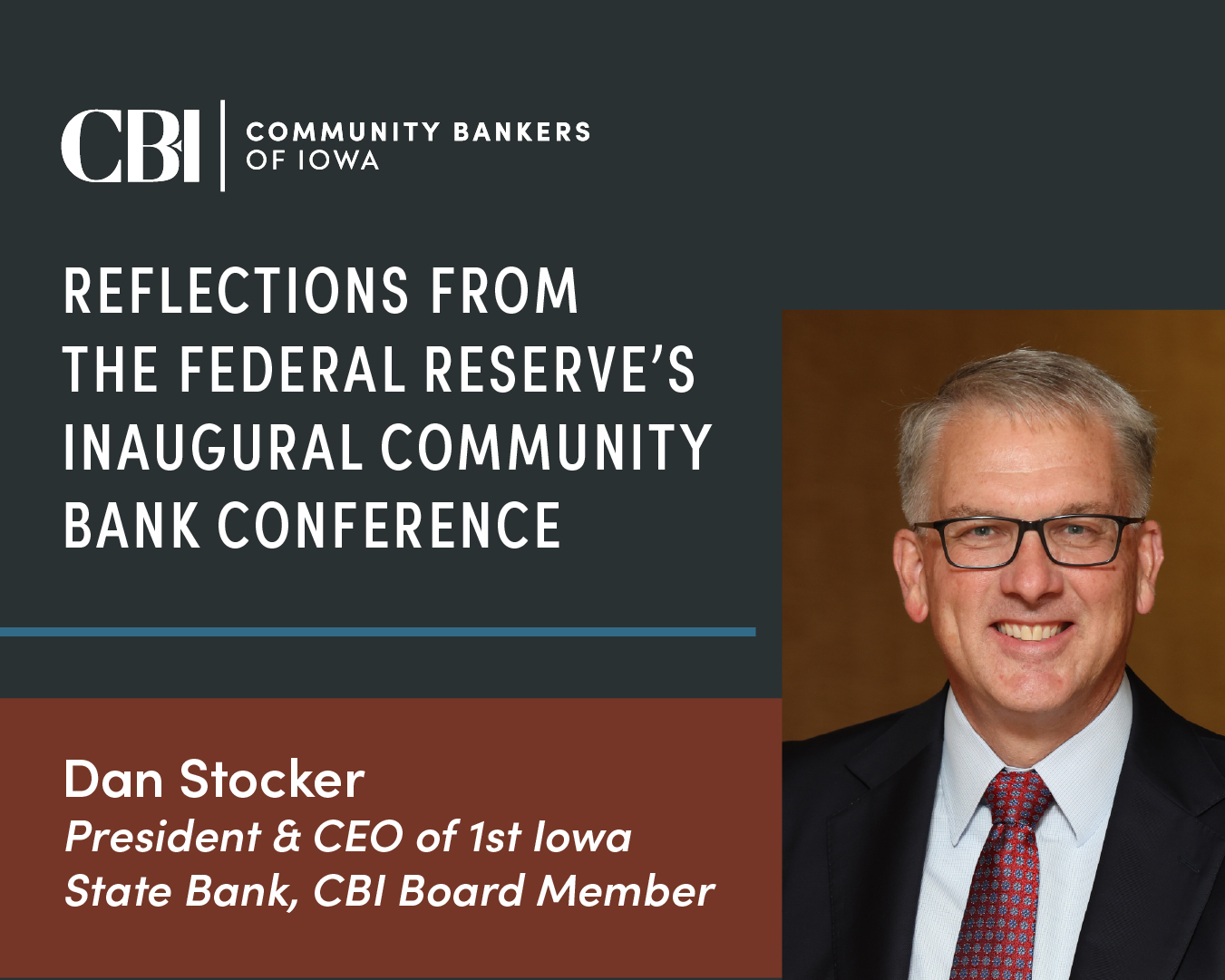
— Dan Stocker, President & CEO, 1st Iowa State Bank, Member Director, CBI Board of Directors
I was truly honored to attend the inaugural Community Bank Conference hosted by the Federal Reserve Board of Governors in Washington, D.C., on October 9, 2025, and to represent both 1st Iowa State Bank and Iowa’s community banking industry.
The event, thoughtfully organized by Vice Chair for Supervision Michelle Bowman, brought together just over 100 community bank CEOs from across the country for a meaningful day of dialogue and learning. I’m sincerely grateful to our Federal Reserve Bank supervisor, Katy Urbain, for the nomination and the opportunity to attend this event. Being able to visit with fellow Iowa banking leaders James Johnson, Superintendent of the Iowa Division of Banking and CEO of PCSB, and Damon Morrison, President and CEO of Pinnacle Bank greatly added to the experience.
The conference focused on the distinct challenges and opportunities facing community banks now and in the years ahead. While many of the issues discussed apply across the financial industry, I appreciated how intentionally the agenda reflected the realities and needs of community institutions like ours.
Regulation, Right-Sized
One of the most pressing discussions centered on modernizing regulatory thresholds. Current asset-based breakpoints, such as those at $500 million and $1 billion, haven’t kept pace with the evolving landscape. The consensus was clear: static thresholds can unintentionally create headwinds for growing banks.
As Treasury Secretary Scott Bessent put it, “Regulations and insurance ensure that some banks are too big to fail. What we need is an easing of regulations so that others aren’t too small to succeed.”
Innovation Is Not Optional
To stay relevant and resilient, community banks must continue to evolve especially in technology. Identifying the right solutions can be challenging, but one thing is certain: if we don’t embrace digital progress, our customers will seek it elsewhere.
Topics like tokenized deposits, blockchain, and stablecoin were front and center, not as abstract concepts, but as emerging tools that will shape our industry’s future. While the path forward is still unfolding, community banks must stay engaged and informed.
Artificial Intelligence (AI) was another key topic. While AI won’t replace the personal relationships we’re known for, it will change how we operate, reducing labor needs in some areas while creating new efficiencies and opportunities.
Protecting Our Identity
Equally important was the concern over the steady decline in bank charters across the country. While consolidation has its place, it also risks eroding the community-centered model that so many of us believe in.
People still value personal connection. Community banks are woven into the fabric of their hometowns. We coach little leagues, donate to bake sales, serve on local boards, and show up when our neighbors need us. That kind of service isn’t easily replicated, and it’s something worth protecting.
Purpose and Momentum
The conference featured a powerful lineup of speakers, including Federal Reserve Chair Jerome Powell, Vice Chair Michelle Bowman, Secretary of the Treasury Scott Bessent, CNBC’s Jim Cramer, and banking leaders from across the country. But what stood out most wasn’t just the names on the agenda, it was the sense of shared purpose in the room.
Community banking has a future, and we have a role in shaping it. I left the conference encouraged, not only by the conversations that took place, but by the people having them.
There’s work to do, and challenges ahead, but also opportunity. We simply need to stay engaged, stay adaptive, and stay true to what makes us different.