

FROM THE FRONT LINES TO THE FRONT OFFICE
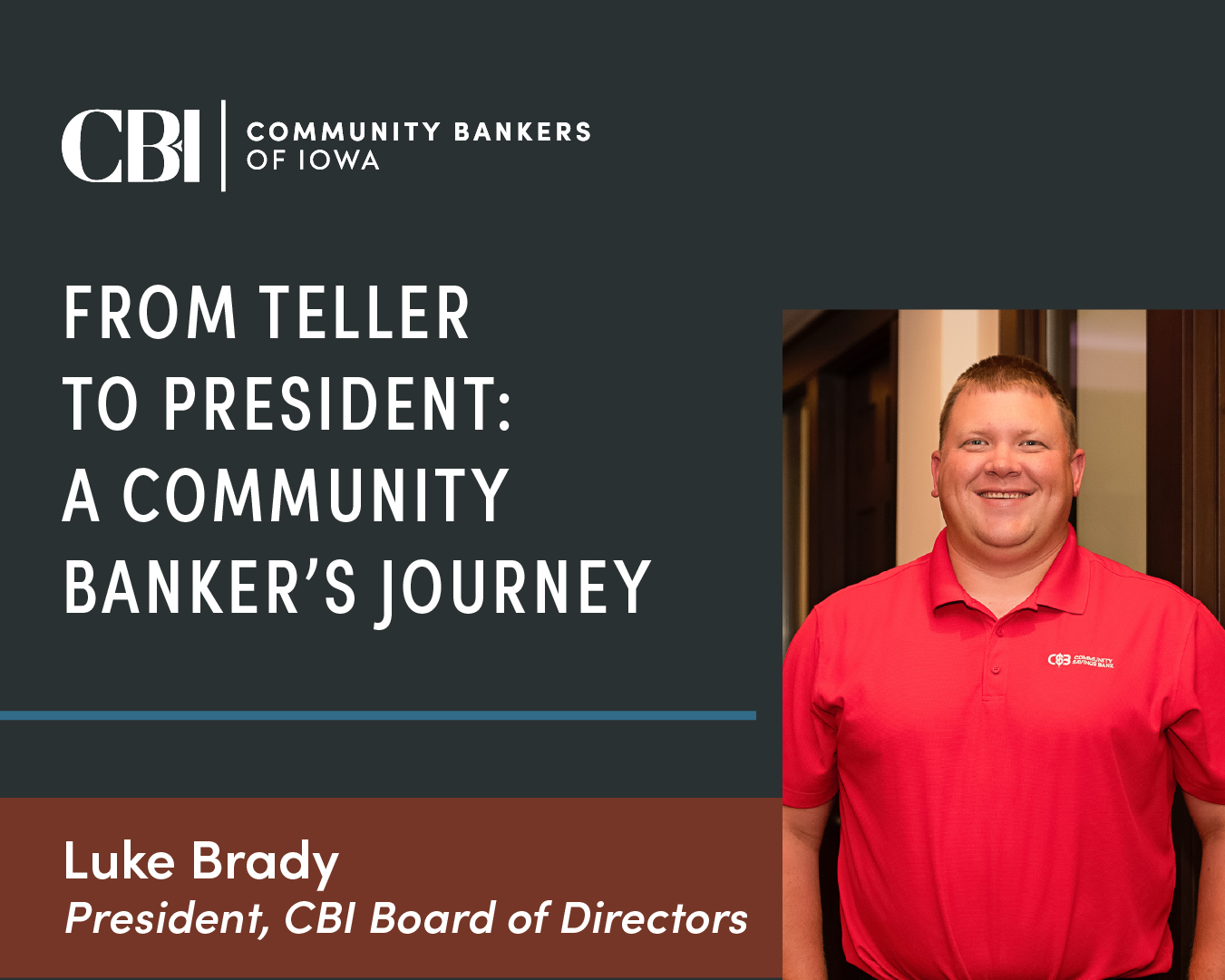
— Luke Brady, President, CBI Board of Directors, President, Community Savings Bank
When you grow up in a community banking household, it’s not just a job. It’s a way of life. For me, conversations about school and practice were shared around the dinner table right alongside discussions about lending, customer service, and regulatory updates. That early exposure sparked a passion that carried me from teller line to boardroom, and ultimately to my current role as President of the Community Bankers of Iowa Board of Directors.
My first day working at the bank was one I’ll never forget, September 11, 2001. I was a high school student, just starting to learn the basics: counting cash, handling night deposits. The world changed that morning, and while my duties were small, the importance of serving people during uncertain times made a lasting impression.
Over the years, I’ve worn many hats: Teller, Credit Analyst, Loan Officer, and now President of our bank. Since 2018, I’ve also had the privilege of serving on our board of directors. That broad experience, especially time spent on the frontlines, continues to shape how I lead today. There’s no better place to truly understand the heartbeat of a community than from the front counter of a community bank. It’s where relationships are built, trust is earned, and local economies move forward.
The Challenge of Relevancy
Community banks today face a growing challenge: staying relevant. We’re not just competing with the bank across town anymore. We’re up against credit unions with tax advantages, technology companies that offer banking-like services without the same level of regulation, and the Farm Credit system that’s drifting far from its original mission.
Credit unions have long been a thorn in our side, but tech companies and Farm Credit present new and mounting pressures. Tech firms are luring customers with slick apps and frictionless interfaces, while Farm Credit’s aggressive interest rates undercut traditional banks. Worse, their government sponsorship gives the illusion of support for riskier borrowers yet they often cherry-pick the best deals, leaving true community banks to step in where others won’t.
Community banks have always been willing to work with people through good times and bad. That’s a legacy worth protecting.
Building Strong Teams and Stronger Communities
At our bank, we believe in building teams that thrive. That means empowering our staff, not micromanaging. We trust our people to do what they do best and give them the flexibility they need to balance work and life. Our commitment isn’t just to profitability, but to the well-being of our team and our community.
That mindset is what drew me to CBI’s Leaders of Tomorrow (LOT) program years ago. It gave me a platform to grow, connect, and eventually serve on the CBI Board. LOT opened doors, introduced me to mentors, and helped me build a network of like-minded professionals I can turn to when tough decisions arise.
Today, as CBI Board President, one of my top priorities is expanding that network. We’re focused on growing both overall CBI membership and LOT involvement. Every bank that joins makes our collective voice stronger whether we’re advocating at the Statehouse in Des Moines or on Capitol Hill in Washington, D.C.
Looking Ahead
CBI’s strength lies in its ability to bring people together to share ideas, tackle challenges, and support each other. That will only grow more important over the next 5 to 10 years. Our role in shaping legislation, amplifying the voice of community banks, and fostering collaboration will be essential as our industry continues to evolve.
Throughout my career, I’ve received many valuable pieces of advice, but a few stand out: “Move forward past issues that are over with.” “Keep it simple.” And perhaps most importantly: “Ask why?”
That’s the heart of community banking: continually learning, adapting, and serving with purpose.